| System | Introduction year | Type | Light source / wavelength (KrF, ArF, EUV) | Projection optics (NA / design) |
|---|---|---|---|---|
| “TWINSCAN EXE:5200B” (2025) | 2025 | EUV | EUV, 13.5 nm wavelength | 0.55-NA anamorphic reflective optics |
| “TWINSCAN XT:400M” (2025) | 2025 | DUV | i-line (Hg) 365 nm | 0.65-NA lens |
| “TWINSCAN EXE:5000” (2024) | 2024 | EUV | EUV, 13.5 nm wavelength | 0.55-NA anamorphic reflective optics (High-NA EUV) |
| “TWINSCAN NXE:3800E” (2024) | 2024 | EUV | EUV, 13.5 nm | 0.33-NA reflective optics |
| “TWINSCAN NXT:870” (2022) | 2022 | DUV | KrF, 248 nm | Variable 0.80-NA refractive lens |
| “TWINSCAN NXT:870B” (2022) | 2022 | DUV | KrF, 248 nm | Variable 0.80-NA lens |
| “TWINSCAN NXE:3600D” (2021) | 2021 | EUV | EUV, 13.5 nm | 0.33-NA reflective optics |
| “TWINSCAN XT:860N” (2021) | 2021 | DUV | KrF, 248 nm | Variable NA 0.55–0.80 lens |
| “TWINSCAN NXE:3400C” (2019) | 2019 | EUV | EUV, 13.5 nm | 0.33-NA reflective optics |
| “TWINSCAN NXT:2050i” (2019) | 2019 | DUV | ArF immersion, 193 nm | 1.35-NA catadioptric lens |
| “NXT:2150i” (2018) | 2018 | DUV | ArF immersion, 193 nm | 1.35-NA lens |
| “TWINSCAN NXE:3400B” (2017) | 2017 | EUV | EUV, 13.5 nm | 0.33-NA reflective 4× reduction optics |
| “NXT:2100i” (2017) | 2017 | DUV | ArF immersion, 193 nm | 1.35-NA lens |
| “NXT:1980Fi” (2016) | 2016 | DUV | ArF immersion, 193 nm | 1.35-NA lens |
| “TWINSCAN NXT:2000i” (2015) | 2015 | DUV | ArF immersion, 193 nm | 1.35-NA lens |
| “TWINSCAN NXT:1470” (2013) | 2013 | DUV | ArF dry, 193 nm | Variable NA 0.70–0.93 Carl Zeiss Starlith lens |
| “TWINSCAN XT:1460K” (2008) | 2008 | DUV | ArF, 193 nm | Variable NA 0.65–0.93 projection lens |
| “TWINSCAN XT:1060K” (2006) | 2006 | DUV | KrF, 248 nm | 0.93-NA catadioptric lens (4× reduction) |
| “TWINSCAN XT:860M” (2021) | 2005 | DUV | KrF, 248 nm | Variable NA 0.55–0.80 lens |
| PAS 5500/1150C (2019) | 2004 | ArF | 193 nm ArF | 0.50–0.75 NA |
| PAS 5500/8TFH-a (2019) | 2003 | KrF | 248 nm KrF | 0.55–0.80 NA (variable) |
| PAS 5500/850C (2019) | 2002 | DUV | 248 nm KrF | 0.55–0.80 NA (variable) |
| PAS 5500/750F (2019) | 2000 | DUV | 248 nm KrF | 0.5–0.7 NA (variable) |
| PAS 5500/450F (2019) | 1998 | i-Line | 365 nm i-line | 0.48–0.65 NA |
| PAS 5500/275D (2019) | 1997 | i-Line | 365 nm i-line | 0.48–0.60 NA (variable) |
| PAS 5500/350C (2019) | 1996 | KrF | 248 nm KrF | 0.40–0.63 NA |
| PAS 5500/100D (2019) | 1995 | i-Line | 365 nm i-line | 0.48—0.60 NA (variable) |
4 ASML Operational Data
In the following sections, you will find data concerning ASML’s operations, including machines, parts, suppliers, customers, and transportation logistics.
4.1 Systems
ASML’s photolithography machines are among the most complex machines in the world, comprising tens of thousands of components. The key products and services offered by ASML are (ASML 2025a):
- EUV Lithography Systems: Extreme ultraviolet lithography systems that provide the highest resolution in high-volume manufacturing, enabling chipmakers to produce cutting-edge chips with more transistors on a single chip. EUV systems are subdivided into (see “ASML EUV Lithography Systems” 2025):
- EXE systems, which are the latest generation of EUV machines designed featuring high numerical aperture (NA) optics for improved resolution and performance.
- NXE systems, which are designed for high-volume manufacturing and support advanced packaging technologies.
- DUV Lithography Systems: Deep ultraviolet lithography systems that are the cornerstone of the semiconductor industry, used for high-volume manufacturing of advanced Logic and Memory chips. DUV systems are subdivided into:
- Immersion systems, which use a liquid medium to improve resolution and are widely used in advanced chip manufacturing.
- Dry systems, which are used for less advanced chips and legacy processes.
- Refurbished Systems: ASML refurbishes older PAS 5500 lithography systems for continued use in customer fabs, extending their lifespan and competitiveness (“Refurbished Systems” 2025). Not all chips require the latest technology, and many fabs still operate older machines that are cost-effective for their needs. These systems are often retrofitted with new optics and lasers to maintain performance.
Besides machines, ASML also provides:
- Metrology and Inspection Systems: Equipment to ensure the quality and precision of semiconductor manufacturing processes, covering every step from R&D to mass production.
- Software Solutions: Computational lithography software that optimizes the design and manufacturing processes, enhancing the performance and yield of semiconductor devices.
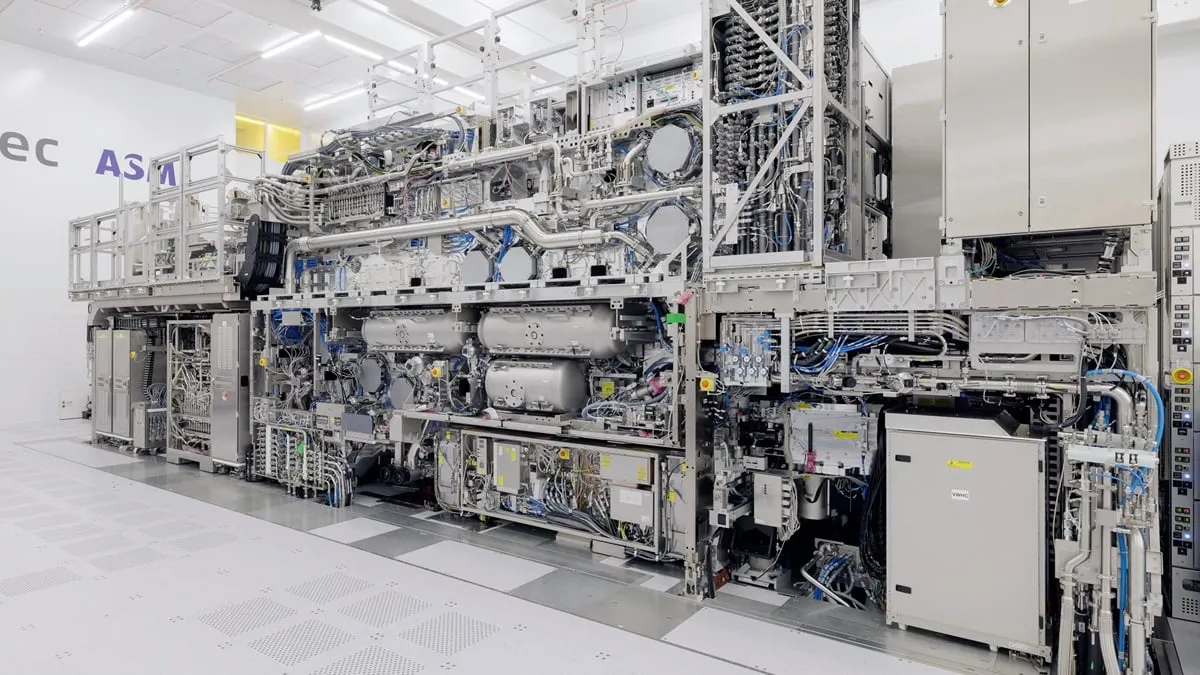
Figure 4.1 shows one of ASML’s latest EUV machine, the TWINSCAN EXE:5000. Weighing 165 tons and costing around $400 million, this machine is designed for the next generation of chips, with a resolution of 13.5 nm and a throughput of 170 wafers per hour.
Table 4.1 provides a comprehensive list of ASML machines.
4.2 Lithography Machine Lifecycle
ASML’s lithography machines undergo a complex lifecycle involving multiple stages from manufacturing to installation at customer sites. The key stages include (Tarasov 2022, 2025; Bloomberg News 2024):
- Module Manufacturing: Components are produced at specialized ASML facilities or by key suppliers, such as Carl Zeiss for optics and Trumpf for lasers.
- Assembly and Testing: After manufacturing, modules are shipped to Veldhoven, where they are assembled into a complete machine and tested in a cleanroom to ensure optimal performance. The machine is then disassembled into modules for final shipment.
- Global Shipment: Modules are packed in specialized containers to maintain precise environmental conditions, such as temperature and vibration control.
- On-Site Installation: At the customer’s fabrication facility, over 250 engineers work for approximately six months to reassemble the modules with nanoscale precision.
- Maintenance and Support: Post-installation, ASML provides ongoing maintenance and support services to ensure optimal performance and minimize downtime.
4.3 Machine Types
ASML’s scanners are grouped by platform families that reflect the light source, numerical aperture, and generation of the TWINSCAN architecture. In this document we use the following families, ordered from legacy DUV to the newest High-NA EUV.
- PAS. Legacy steppers and early step-and-scan systems for DUV. Primarily i-line \(365,\text{nm}\) and KrF \(248,\text{nm}\), with some ArF \(193,\text{nm}\) variants. Common in 200 mm (8-inch) wafer fabs, still relevant for mature nodes and specialty processes.
- NXT. Modern high-productivity DUV on the TWINSCAN platform. Includes ArF immersion \(193,\text{nm}\) (\(\text{NA}\approx1.35\)) for critical layers and KrF \(248,\text{nm}\) dry for non-critical layers. Designed for 300 mm high-volume manufacturing and mix-and-match with EUV.
- NXE. EUV \(13.5,\text{nm}\) scanners with reflective optics and \(\text{NA}=0.33\). Workhorse for advanced nodes, enabling single-exposure EUV on 7 nm, 5 nm, 3 nm and beyond with high throughput and tight overlay.
- EXE. Next-generation High-NA EUV \(13.5,\text{nm}\) with \(\text{NA}=0.55\) and anamorphic optics. Targets single-exposure patterning at smaller pitches and enables further design-rule scaling for the most advanced logic and memory processes.
Each machine type includes two equipment areas that matter for parts and layout:
- Scanner. The main lithography tool installed on the production floor. This includes all components directly integrated into the tool, such as the tool frame, projection and illumination optics, wafer and reticle stages, on-tool control racks, sensors, cabling, and enclosures.
- Sub-fab. The dedicated equipment area located directly beneath the production floor, housing the tool’s auxiliary systems. This includes vacuum pumps, boosters, abatement systems, power modules, cooling and DI-water skids, vibration-isolation frames, and manifolds that are exclusively used by the tool.
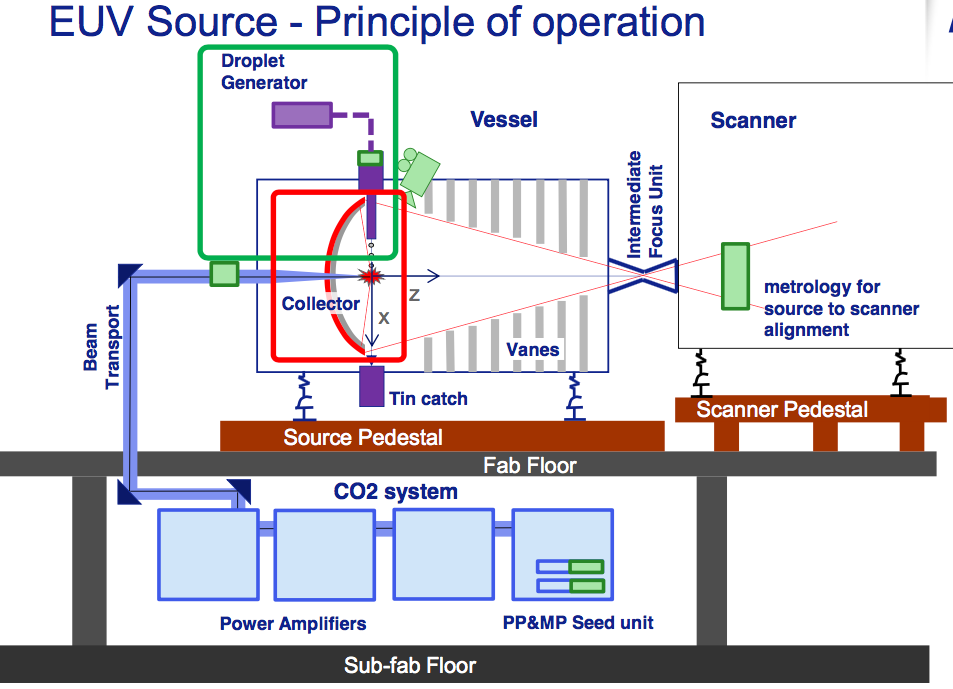
Table 4.2 provides an overview of the volumes of ASML machine types, considering their two primary equipment areas: the scanner and the sub-fab. These values represent averages across different configurations within each machine type. For instance, the TWINSCAN EXE 5000, depicted in Figure 4.3, is comparable in size to a double-decker bus.
| L (m) | W (m) | H (m) | Volume (m³) | ||
|---|---|---|---|---|---|
| type | category | ||||
| PAS | Scanner | 2.8 | 2.30 | 2.4 | 15.46 |
| Sub-fab | 2.8 | 2.30 | 2.8 | 18.03 | |
| NXT | Scanner | 5.2 | 2.60 | 3.1 | 41.91 |
| Sub-fab | 5.2 | 2.60 | 3.4 | 45.97 | |
| NXE | Scanner | 6.0 | 4.50 | 3.8 | 102.60 |
| Sub-fab | 6.0 | 4.50 | 3.8 | 102.60 | |
| EXE | Scanner | 12.0 | 2.55 | 4.0 | 122.40 |
| Sub-fab | 12.0 | 2.55 | 2.0 | 61.20 |
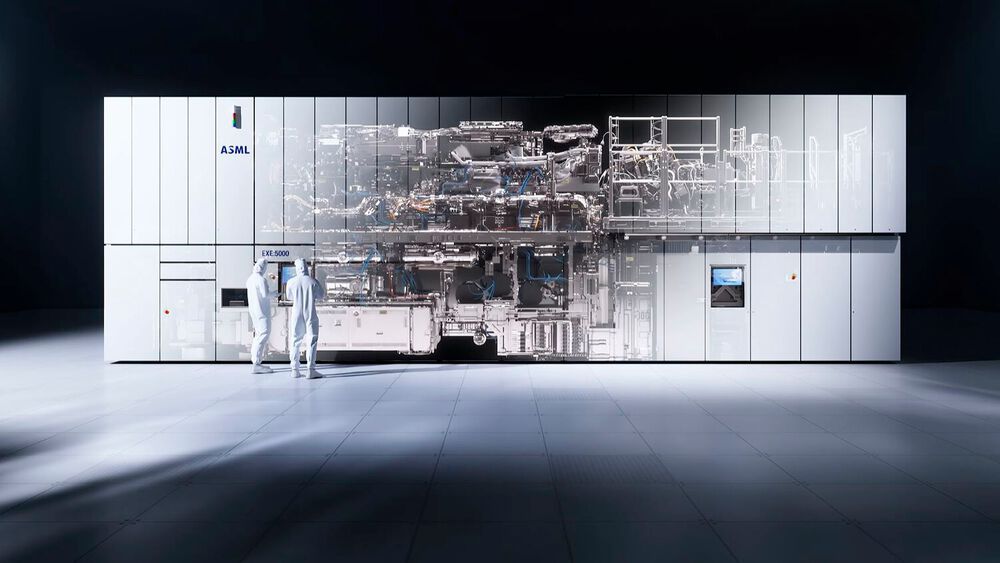
Table 4.2 shows the number of parts per machine type and service area category.
| machine_type | platform | n_parts_scanner | n_parts_sub_fab | n_parts_total | |
|---|---|---|---|---|---|
| 0 | TWINSCANEXE5200B | EXE | 82234 | 51192 | 133426 |
| 1 | TWINSCANXT400M | NXT | 39944 | 17275 | 57220 |
| 2 | TWINSCANEXE5000 | EXE | 73098 | 50484 | 123582 |
| 3 | TWINSCANNXE3800E | NXE | 63402 | 41335 | 104738 |
| 4 | TWINSCANNXT870 | NXT | 38467 | 15796 | 54263 |
| 5 | TWINSCANNXT870B | NXT | 40192 | 17141 | 57334 |
| 6 | TWINSCANNXE3600D | NXE | 63207 | 44367 | 107575 |
| 7 | TWINSCANXT860N | NXT | 39399 | 15791 | 55191 |
| 8 | TWINSCANNXE3400C | NXE | 64161 | 39986 | 104147 |
| 9 | TWINSCANNXT2050i | NXT | 40191 | 16458 | 56649 |
| 10 | NXT2150i | NXT | 38144 | 15938 | 54082 |
| 11 | TWINSCANNXE3400B | NXE | 66851 | 41675 | 108526 |
| 12 | NXT2100i | NXT | 37675 | 16209 | 53884 |
| 13 | NXT1980Fi | NXT | 39524 | 16801 | 56326 |
| 14 | TWINSCANNXT2000i | NXT | 39294 | 16855 | 56149 |
| 15 | TWINSCANNXT1470 | NXT | 42622 | 16164 | 58787 |
| 16 | TWINSCANXT1460K | NXT | 37513 | 15828 | 53342 |
| 17 | TWINSCANXT1060K | NXT | 39685 | 17431 | 57117 |
| 18 | TWINSCANXT860M | NXT | 38280 | 15806 | 54087 |
| 19 | PAS55001150C | PAS | 18983 | 2271 | 21255 |
| 20 | PAS55008TFHa | PAS | 20535 | 2259 | 22795 |
| 21 | PAS5500850C | PAS | 19141 | 2225 | 21366 |
| 22 | PAS5500750F | PAS | 19915 | 2224 | 22139 |
| 23 | PAS5500450F | PAS | 20662 | 2224 | 22887 |
| 24 | PAS5500275D | PAS | 20472 | 2207 | 22679 |
| 25 | PAS5500350C | PAS | 20086 | 2269 | 22355 |
| 26 | PAS5500100D | PAS | 18357 | 2164 | 20522 |
4.4 Factories
ASML’s factories are the backbone of its manufacturing and assembly operations. The main factories are located in:
- Veldhoven (Netherlands): The primary manufacturing site for EUV and DUV systems, where the most advanced machines are assembled and tested.
- Tainan/Linkou (Taiwan): Focuses on high-volume DUV production and module assembly for the Asia-Pacific region.
- Wilton (Connecticut, US): Manufactures optics and modules, supporting North American customers.
- San Diego (California, US): Produces light sources via Cymer, which are critical for EUV machines.
- Berlin (Germany): Specializes in optics and modules, particularly for EUV systems.
For example, the TWINSCAN EXE:5000, ASML’s latest High-NA EUV machine, comprises four modules, manufactured in Connecticut, California, Germany, and the Netherlands. The machine is assembled in Veldhoven, Netherlands, for testing and approval before being disassembled again for shipment to customers (Tarasov 2025).
Factories are sourced with components from more than 5,000 suppliers, being the first step in the supply chain before parts flow to central warehouses and then to local warehouses for customer delivery.
All machines are sent to the Veldhoven (EUV and DUV) or Tainan/Linkou (DUV) factories for assembly and testing before being shipped to customers. The factories are equipped with cleanrooms to ensure the precision required for lithography machines.
US and German factories are auxiliary sites that support the main operations in the Netherlands and Taiwan, focusing on specific components like optics and light sources.
Table 4.4 provides a list of ASML factories.
| Factory_Name | Address | Latitude | Longitude | |
|---|---|---|---|---|
| Factory_ID | ||||
| ASML-F-01 | ASML Veldhoven (Netherlands) Factory | De Run 6501, 5504 DR, Veldhoven, The Netherlands | 51.4167 | 5.4750 |
| ASML-F-02 | ASML Berlin (Germany) Factory | Waldkraiburger Straße 5, 12347, Berlin, Germany | 52.4269 | 13.4899 |
| ASML-F-03 | ASML Linkou (Taiwan) Factory | No. 59, Keji 6th Rd., Hwa-Ya Technology Park, ... | 25.0600 | 121.2200 |
| ASML-F-04 | ASML Tainan (Taiwan) Factory | No. 9, Dali 1st Rd., Xinshi Dist., Tainan City... | 23.0900 | 120.3000 |
| ASML-F-05 | ASML San Diego (United States) Factory | 17075 Thornmint Court, San Diego, California 9... | 33.0200 | -117.0800 |
4.5 Warehouses
ASML’s warehouses are categorized into central, regional, and local types, each serving distinct roles in the supply chain.
Central warehouses, are global distribution centers (GDCs) that hold large inventories of spare parts and service tools. They are responsible for:
- Scheduled Replenishments: Regularly supplying local warehouses with spare parts and service tools to maintain optimal inventory levels.
- Emergency Shipments: Executing urgent shipments when local warehouses run out of critical parts, ensuring rapid response to customer needs.
Regional warehouses, are regional distribution centers (RDCs) that act as intermediaries between central and local warehouses. They focus on:
- Buffer Stock: Holding additional inventory to quickly replenish local warehouses and reduce lead times.
- Geographical Coverage: Serving multiple local warehouses within a specific region to optimize logistics and distribution.
Local warehouses are field stocking locations (FSLs) that serve specific customer sites. They focus on:
- Rapid Response: Providing quick access to spare parts and service tools for nearby customers, minimizing downtime.
- Local Inventory Management: Maintaining optimal inventory levels at local warehouses to meet customer demand without delays.
Lateral Transhipments
Local warehouses are strategically located near major customer fabs to ensure fast delivery of critical parts. When a customer fab requires a spare part, the local warehouse checks its inventory and the inventory of nearby warehouses in the same region. If the part is available locally, it is shipped directly to the customer site. This is referred to as lateral transhipment. If the part is not available locally, it can be sourced from a central warehouse (i.e., GDC), which may involve air freight for critical components to meet service level agreements.
Table 4.5 shows the ASML warehouse information and Figure 4.4 illustrates the locations of ASML’s warehouses on a map, with colors indicating warehouse types and sizes based on their capacities.
| Location_Name | Address | Latitude | Longitude | Region | Warehouse_Type | Warehouse_Capacity_m3 | OrderProcessingTime_h | SKU_Breadth | Coverage_Days | |
|---|---|---|---|---|---|---|---|---|---|---|
| Warehouse_ID | ||||||||||
| ASML-WH-41 | ASML Linkou Factory | No. 59, Keji 6th Rd., Hwa-Ya Technology Park, ... | 25.0600 | 121.2200 | APAC | Central | 106614 | 45 | 800 | 14 |
| ASML-WH-42 | ASML Tainan Factory | No. 9, Dali 1st Rd., Xinshi Dist., Tainan City... | 23.0900 | 120.3000 | APAC | Central | 104381 | 45 | 800 | 14 |
| ASML-WH-00 | ASML Veldhoven (Global Headquarters) | De Run 6501, 5504 DR, Veldhoven, The Netherlands | 51.4167 | 5.4750 | EMEA | Central | 101916 | 50 | 800 | 14 |
| ASML-WH-02 | ASML Crolles | 127, Rue Marcel Reynaud, 38920, Crolles, France | 45.2977 | 5.8980 | EMEA | Regional | 22596 | 19 | 500 | 7 |
| ASML-WH-13 | ASML Beijing | Ronghua Middle Road 19, 10F, Block B, Building... | 39.9590 | 116.4620 | APAC | Regional | 21986 | 25 | 500 | 7 |
| ASML-WH-07 | ASML Kiryat-Gat | Mevo Sivan Street 1, 2F, 82021, Kiryat-Gat, Is... | 31.6110 | 34.7660 | EMEA | Regional | 21363 | 32 | 500 | 7 |
| ASML-WH-52 | ASML Lehi | 4000 N Flash Drive, Building 20, c/o Texas Ins... | 40.4300 | -111.8800 | Americas | Regional | 21272 | 26 | 500 | 7 |
| ASML-WH-24 | ASML Tokyo (Japan Headquarters) | Kita Shinagawa 4-7-35, 4F, Gotenyama Trust Tow... | 35.6250 | 139.7400 | APAC | Regional | 21232 | 24 | 500 | 7 |
| ASML-WH-20 | ASML Wuxi | Hefeng Road 26, Xinfa Huirong Plaza, 214028, W... | 31.5500 | 120.3500 | APAC | Regional | 20887 | 14 | 500 | 7 |
| ASML-WH-30 | ASML Yokkaichi | Yasujima 2-1-15, Masuda Building, 510-0075, Yo... | 34.9650 | 136.6200 | APAC | Regional | 20660 | 27 | 500 | 7 |
| ASML-WH-51 | ASML Hillsboro | 7451 NE Evergreen Parkway, Two Technology Buil... | 45.5800 | -122.9100 | Americas | Regional | 19987 | 27 | 500 | 7 |
| ASML-WH-03 | ASML Berlin | Waldkraiburger Straße 5, 12347, Berlin, Germany | 52.4269 | 13.4899 | EMEA | Regional | 19855 | 12 | 500 | 7 |
| ASML-WH-45 | ASML Boise | 3130 S. Owyhee Street, Parkview Plaza, Boise, ... | 43.5800 | -116.2200 | Americas | Regional | 19602 | 25 | 500 | 7 |
| ASML-WH-39 | ASML Pyeongtaek | 4F~8F, 128 Dosijiwon-ro, Godeok-myeon, Pyeongt... | 37.0400 | 127.1000 | APAC | Regional | 19386 | 30 | 500 | 7 |
| ASML-WH-57 | ASML Silicon Valley | 80 West Tasman, San Jose, California 95131, Un... | 37.4100 | -121.9500 | Americas | Regional | 19362 | 23 | 500 | 7 |
| ASML-WH-12 | ASML Shanghai (Chinese mainland Headquarters) | Jinke Road 2889, No1 Block A / No2 Block B, Ch... | 31.1850 | 121.5870 | APAC | Regional | 18945 | 27 | 500 | 7 |
| ASML-WH-19 | ASML Wuhan | Gaoxin Avenue, 999, 12F, Building 3, Block C, ... | 30.5800 | 114.2700 | APAC | Regional | 18738 | 12 | 500 | 7 |
| ASML-WH-54 | ASML North Phoenix | 25700 Norterra Dr, Phoenix, AZ 85085, United S... | 33.7200 | -112.1300 | Americas | Regional | 17668 | 14 | 500 | 7 |
| ASML-WH-59 | ASML Wilton | 77 Danbury Road, Wilton, Connecticut 06897, Un... | 41.1900 | -73.4300 | Americas | Regional | 17609 | 15 | 500 | 7 |
| ASML-WH-37 | ASML Cheongju | Unit #101, Ground Floor(1F), 141 Jinjae-ro, He... | 36.6300 | 127.4500 | APAC | Regional | 16086 | 18 | 500 | 7 |
| ASML-WH-34 | ASML Hwasung (South Korea Headquarters) | 25 Samsung 1-ro 5-gil, Hwasung-si, Gyeonggi-do... | 37.2000 | 127.0700 | APAC | Regional | 15982 | 35 | 500 | 7 |
| ASML-WH-53 | ASML Manassas | Innovation Drive, 9450, Ground Floor, Unit 1, ... | 38.7500 | -77.4700 | Americas | Regional | 15801 | 27 | 500 | 7 |
| ASML-WH-40 | ASML Hsinchu (Taiwan Headquarters) | 11F., No. 1, Sec. 3, Gongdao 5th Rd., East Dis... | 24.8050 | 120.9750 | APAC | Regional | 15431 | 29 | 500 | 7 |
| ASML-WH-43 | ASML Albany | 255 Fuller Road, NanoFab South, Albany, New Yo... | 42.6900 | -73.8500 | Americas | Regional | 14587 | 16 | 500 | 7 |
| ASML-WH-10 | ASML Delft | Computerlaan 15, 2628 XK, Delft, The Netherlands | 51.9990 | 4.3800 | EMEA | Regional | 14303 | 18 | 500 | 7 |
| ASML-WH-33 | ASML Singapore | 151 Lorong Chuan, New Tech Park #06-08, 556741... | 1.3510 | 103.8650 | APAC | Regional | 14297 | 14 | 500 | 7 |
| ASML-WH-32 | ASML Kulim | Khtp Business Centre, 2F Suite 2.02, Kulim Hi-... | 5.4000 | 100.5700 | APAC | Regional | 13539 | 14 | 500 | 7 |
| ASML-WH-44 | ASML Austin | 201 West Howard Lane, Suite 300, Austin, Texas... | 30.4000 | -97.6700 | Americas | Regional | 12901 | 19 | 500 | 7 |
| ASML-WH-38 | ASML Icheon | 866 Daewol-ro, Daewol-myeon, Icheon-si, Gyeong... | 37.2300 | 127.4900 | APAC | Regional | 11857 | 35 | 500 | 7 |
| ASML-WH-25 | ASML Hiroshima | Saijo Okamachi 10-7, Higashi Hiroshima-shi, Hi... | 34.4300 | 132.7500 | APAC | Regional | 11308 | 15 | 500 | 7 |
| ASML-WH-35 | HMI Hwasung | 9F, 6 Samsung 1-ro 5-gil, Hwasung-si, Gyeonggi... | 37.2000 | 127.0700 | APAC | Regional | 11221 | 33 | 500 | 7 |
| ASML-WH-46 | ASML Chandler | 2625 West Geronimo Place, Chandler, Arizona 85... | 33.3000 | -111.8800 | Americas | Regional | 10375 | 16 | 500 | 7 |
| ASML-WH-36 | Hwasung 2 (DUV, Cymer, LRC-2) | 27 Dongtanchumdansanup 1-ro, Hwasung-si, Gyeon... | 37.1900 | 127.0800 | APAC | Regional | 10208 | 28 | 500 | 7 |
| ASML-WH-08 | ASML Migdal Ha'emek | Ramat Gabriel Industry Area, 5 Africa Israel B... | 32.6770 | 35.2400 | EMEA | Regional | 10177 | 17 | 500 | 7 |
| ASML-WH-56 | ASML San Diego | 17075 Thornmint Court, San Diego, California 9... | 33.0200 | -117.0800 | Americas | Regional | 9947 | 12 | 500 | 7 |
| ASML-WH-04 | ASML Dresden | Hermann-Reichelt-Straße 3a, 01109, Dresden, Ge... | 51.0942 | 13.7810 | EMEA | Regional | 9601 | 22 | 500 | 7 |
| ASML-WH-27 | ASML Kumamoto | Carino Kikuyo 3F, 2422-4 Tsukure, Kikuyo-machi... | 32.8600 | 130.7900 | APAC | Regional | 8744 | 22 | 500 | 7 |
| ASML-WH-48 | ASML Dallas | 870 North Dorothy Drive, Suite 706, Richardson... | 32.9600 | -96.7100 | Americas | Regional | 8125 | 30 | 500 | 7 |
| ASML-WH-05 | ASML Erlangen | Staudtstrasse 2, Max Planck Institut, 91058, E... | 49.5950 | 11.0050 | EMEA | Local | 2934 | 4 | 200 | 1 |
| ASML-WH-22 | ASML Xian | Jin Ye Road 70, 6F, 710077, Xian, China | 34.2000 | 108.8800 | APAC | Local | 2920 | 6 | 200 | 1 |
| ASML-WH-31 | ASML Chitose | Chitose Station Plaza 3F, 1789-3, Chiyoda-Cho ... | 42.8200 | 141.6500 | APAC | Local | 2912 | 5 | 200 | 1 |
| ASML-WH-11 | ASML Bellshill | Grovewood Business Centre, Suite 51, ML4 3NQ, ... | 55.8170 | -4.0240 | EMEA | Local | 2802 | 4 | 200 | 1 |
| ASML-WH-23 | HMI Beijing | Liye Rd 8, International Information Park, Bei... | 40.0400 | 116.3100 | APAC | Local | 2711 | 3 | 200 | 1 |
| ASML-WH-18 | ASML Tianjin | Race Course Road 59, 25F, Units 09, 10 & 11, P... | 39.1350 | 117.2000 | APAC | Local | 2534 | 3 | 200 | 1 |
| ASML-WH-49 | ASML Eagan | 2020 Silver Bell Road, Suite 1, Eagan, Minneso... | 44.8200 | -93.2000 | Americas | Local | 2424 | 9 | 200 | 1 |
| ASML-WH-06 | ASML Maynooth | Maynooth Business Park, Block C Office, Ground... | 53.3799 | -6.5920 | EMEA | Local | 2355 | 6 | 200 | 1 |
| ASML-WH-29 | ASML Tsuruoka | 2-68 Nishiki-machi, Tsuruoka-shi, SS Building ... | 38.7300 | 139.8300 | APAC | Local | 2144 | 5 | 200 | 1 |
| ASML-WH-50 | ASML Fishkill | 60 Merritt Boulevard, Suite 105, Fishkill, New... | 41.5300 | -73.9000 | Americas | Local | 2095 | 6 | 200 | 1 |
| ASML-WH-16 | ASML Jinjiang | Changxing Road 208, 22F, Minxing Fortune Cente... | 24.8070 | 118.5780 | APAC | Local | 1797 | 6 | 200 | 1 |
| ASML-WH-58 | HMI San Jose | 80 West Tasman, San Jose, California 95131, Un... | 37.4100 | -121.9500 | Americas | Local | 1571 | 5 | 200 | 1 |
| ASML-WH-26 | ASML Kitakami | Iwate-Jisho Kitakami-Ekimae Bldg. 5F, 2-3-8 Od... | 39.2860 | 141.1170 | APAC | Local | 1560 | 8 | 200 | 1 |
| ASML-WH-09 | ASML Avezzano | Piazzale J.F. Kennedy, Scala A - IV Piano Grou... | 42.0280 | 13.4260 | EMEA | Local | 1516 | 2 | 200 | 1 |
| ASML-WH-14 | ASML Dalian | Yong De Street 1, 11F, Unit 9-13, Jinma Intern... | 38.9140 | 121.6140 | APAC | Local | 1497 | 9 | 200 | 1 |
| ASML-WH-01 | ASML Leuven | Kapeldreef 75, B-3001, Leuven, Belgium | 50.8798 | 4.7012 | EMEA | Local | 1484 | 7 | 200 | 1 |
| ASML-WH-21 | ASML Xiamen | Lianting Road 837, 5F, Unit 01 & 02, Xiamen, C... | 24.4790 | 118.0890 | APAC | Local | 1257 | 9 | 200 | 1 |
| ASML-WH-15 | ASML Hefei | Chuangxin Avenue, Room 701, 702 & 802, Tower A... | 31.8200 | 117.2300 | APAC | Local | 913 | 8 | 200 | 1 |
| ASML-WH-47 | ASML Clifton Park | 800 State Route 146, Suite 365, Town Plaza, Cl... | 42.8700 | -73.7800 | Americas | Local | 839 | 10 | 200 | 1 |
| ASML-WH-28 | ASML Nagasaki | Higashikouji-Machi 28-3, 4F, Room 401, Shigyo ... | 32.7500 | 129.8700 | APAC | Local | 716 | 5 | 200 | 1 |
| ASML-WH-55 | ASML Westbrook | 590 County Road, Suite 1, Westbrook, ME 04092,... | 43.6700 | -70.3600 | Americas | Local | 677 | 6 | 200 | 1 |
| ASML-WH-17 | ASML Nanjing | Tuan Jie Road 99, 210001, Nanjing, China | 32.0600 | 118.7960 | APAC | Local | 472 | 10 | 200 | 1 |
Make this Notebook Trusted to load map: File -> Trust Notebook
Table 4.6 summarizes the characteristics of ASML’s central, regional, and local warehouses, providing key parameters for each echelon.
- Processing time (hours): administrative + pick/pack release only; transport lead time is separate.
- Coverage target: how many days/weeks of regional/global demand the echelon is designed to buffer.
- Typical stock: general guidelines on inventory types held at each echelon.
| Echelon | Processing time (h) | Coverage target | Typical stock |
|---|---|---|---|
| Central (CWH) | 24–72 | 6–12 wks global | Slow movers; long-LT modules; high-value low-velocity items |
| Regional (RDC) | 12–36 | 2–4 wks region | Medium movers; regional critical sets; kits |
| Local (FSL) | 2–12 | 1–3 days local | Fast movers; high-criticality spares; service tools |
4.6 Suppliers
ASML has a broad supplier network, with 85% of the parts in their machines produced by suppliers. They maintain long-term relationships and involve suppliers early in product development. The majority of suppliers are located in the Netherlands and EMEA1, with a growing presence in North America and Asia. Most supply chain investment is focused on around 200 “critical” suppliers (ASML 2025b). A critical supplier is, for example, Zeiss, which provides the projection optics for EUV machines (ZEISS 2024).
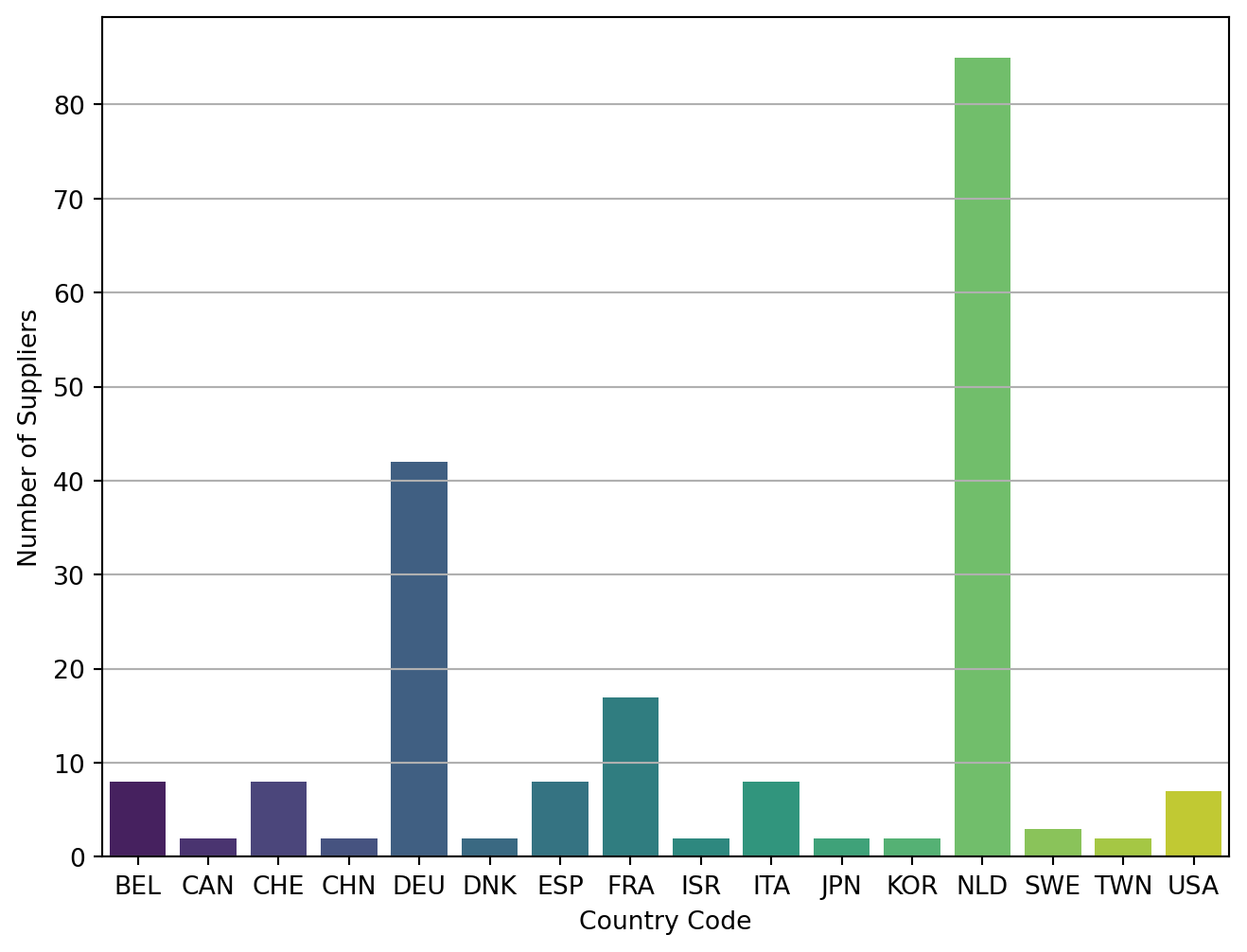
Table 4.7 provides a sample of ASML suppliers across different regions, highlighting their global presence. Figure 4.6 visualizes the geographic distribution of these suppliers on a world map, while Figure 4.5 illustrates the number of suppliers by country, emphasizing the concentration in specific regions.
| supplier_id | country_code | region | longitude | latitude | |
|---|---|---|---|---|---|
| 0 | s-00001-NLD | NLD | Europe | 4.353779 | 51.407881 |
| 1 | s-00002-NLD | NLD | Europe | 6.096683 | 52.635331 |
| 2 | s-00003-NLD | NLD | Europe | 3.415200 | 51.341911 |
| 3 | s-00004-NLD | NLD | Europe | 5.769638 | 52.278704 |
| 4 | s-00005-NLD | NLD | Europe | 6.358616 | 52.693362 |
Make this Notebook Trusted to load map: File -> Trust Notebook
4.7 Parts and Components
ASML machines are composed of several components, each made up of multiple parts. A component is called a FRU (Field Replaceable Unit) and is identified by a unique 12NC code (a 12-digit numeric code formatted as ‘XXXX.XXXX.XXXX’). Each component is supplied by a specific 1st-tier supplier. A supplier can provide multiple components, for example, that are used in different machine types. Components can be broken down into multiple parts, each also identified by a unique 12NC code. Each part has a quantity indicating how many of that part are needed to assemble one unit of the component. For example, the illumination system of the High-NA-EUV lithography consists of around 25,000 parts and weighs more than six tons, whereas the projection optics features 40,000 parts, weighs around twelve tons (ZEISS 2024). Among these parts, several are repeated multiple times within the same component (think of screws, bolts, etc.).
Table 4.8 shows a sample of parts used in different ASML machine types and their quantity per machine.
| machine | system | qty_part | |
|---|---|---|---|
| part_id | |||
| 4030.5340.6162 | PAS5500100D | PAS | 14 |
| 4030.5340.6162 | PAS5500275D | PAS | 1 |
| 4030.5340.6162 | PAS5500750F | PAS | 14 |
| 4030.5340.6162 | PAS5500850C | PAS | 6 |
| 4030.5340.6162 | PAS5500350C | PAS | 12 |
| 4030.5340.6162 | PAS55001150C | PAS | 7 |
| 4030.5340.6162 | TWINSCANXT860N | NXT | 4 |
| 4030.5340.6162 | TWINSCANNXT870 | NXT | 11 |
| 4030.5340.6162 | TWINSCANXT860M | NXT | 8 |
| 4030.5340.6162 | NXT2150i | NXT | 4 |
Table 4.9 shows a sample of parts and their associated suppliers.
| supplier_id | |
|---|---|
| part_id | |
| 4030.5340.6162 | s-00186-USA |
| 4030.2590.1807 | s-00099-DEU |
| 4030.8510.0370 | s-00176-CHE |
| 4030.2839.0813 | s-00021-NLD |
| 4030.2658.6691 | s-00092-DEU |
| 4030.8775.2124 | s-00151-ITA |
| 4030.2829.8141 | s-00167-BEL |
| 4030.0374.0545 | s-00124-DEU |
| 4030.2450.3347 | s-00098-DEU |
| 4030.9451.7311 | s-00095-DEU |
A supplier, however, does not provide parts separately but rather as part of a component. Table 4.10 shows a sample of components and their associated parts.
| part_id | supplier_id | |
|---|---|---|
| component_id | ||
| 4030.460.534 | 4030.9872.0119 | s-00001-NLD |
| 4030.460.534 | 4030.7342.1240 | s-00001-NLD |
| 4030.460.534 | 4030.0964.0202 | s-00001-NLD |
| 4030.460.534 | 4030.0602.0093 | s-00001-NLD |
| 4030.460.534 | 4030.7076.6847 | s-00001-NLD |
| 4030.460.534 | 4030.2545.6946 | s-00001-NLD |
| 4030.460.534 | 4030.7632.3479 | s-00001-NLD |
| 4030.460.534 | 4030.7178.5169 | s-00001-NLD |
| 4030.460.534 | 4030.3818.3764 | s-00001-NLD |
| 4030.460.534 | 4030.6722.5832 | s-00001-NLD |
A total of 5,400 components are used across 27 machines, made up of 200,212 unique parts supplied by ASML’s 200 suppliers.
Creating a component requires substantial effort from suppliers and is associated with a lead time. The lead time for each component is detailed in Table 4.11. Furthermore, each supplier has a limited “work in progress” (WIP) capacity, which represents the maximum number of components they can handle simultaneously. Table 4.12 provides an overview of suppliers and their respective WIP capacities. Therefore, if a supplier is already at full WIP capacity, any new orders for components from that supplier will experience delays until capacity becomes available.
| supplier_id | lead_time_weeks | |
|---|---|---|
| component_id | ||
| 4030.460.534 | s-00001-NLD | 8 |
| 4030.013.182 | s-00002-NLD | 13 |
| 4030.806.484 | s-00003-NLD | 10 |
| 4030.122.072 | s-00004-NLD | 9 |
| 4030.989.805 | s-00005-NLD | 6 |
| 4030.480.835 | s-00006-NLD | 6 |
| 4030.910.243 | s-00007-NLD | 5 |
| 4030.164.180 | s-00008-NLD | 12 |
| 4030.821.703 | s-00009-NLD | 9 |
| 4030.034.101 | s-00010-NLD | 10 |
| wip_capacity | |
|---|---|
| supplier_id | |
| s-00001-NLD | 4 |
| s-00002-NLD | 6 |
| s-00003-NLD | 5 |
| s-00004-NLD | 1 |
| s-00005-NLD | 7 |
| s-00006-NLD | 8 |
| s-00007-NLD | 4 |
| s-00008-NLD | 4 |
| s-00009-NLD | 3 |
| s-00010-NLD | 4 |
4.8 Machine Order History
Since ASML machines are highly specialized and expensive, they are ordered well in advance. The order history captures the timeline from order placement to machine delivery and installation. This includes the manufacturing, assembly, and shipping processes, which can take several months. Table 4.13 shows a sample of the order history of ASML machines across various customer sites.
The dataset includes the following columns:
- Customer: The customer that ordered the machine.
- Fab: The fabrication plant (fab) where the machine is installed.
- Count: The number of machines of a specific model ordered by the customer.
- Order_Date: The date when the order was placed.
- Delivery_Date: The date agreed for delivery of the machine.
- Machine_Model: The model of the ASML machine ordered.
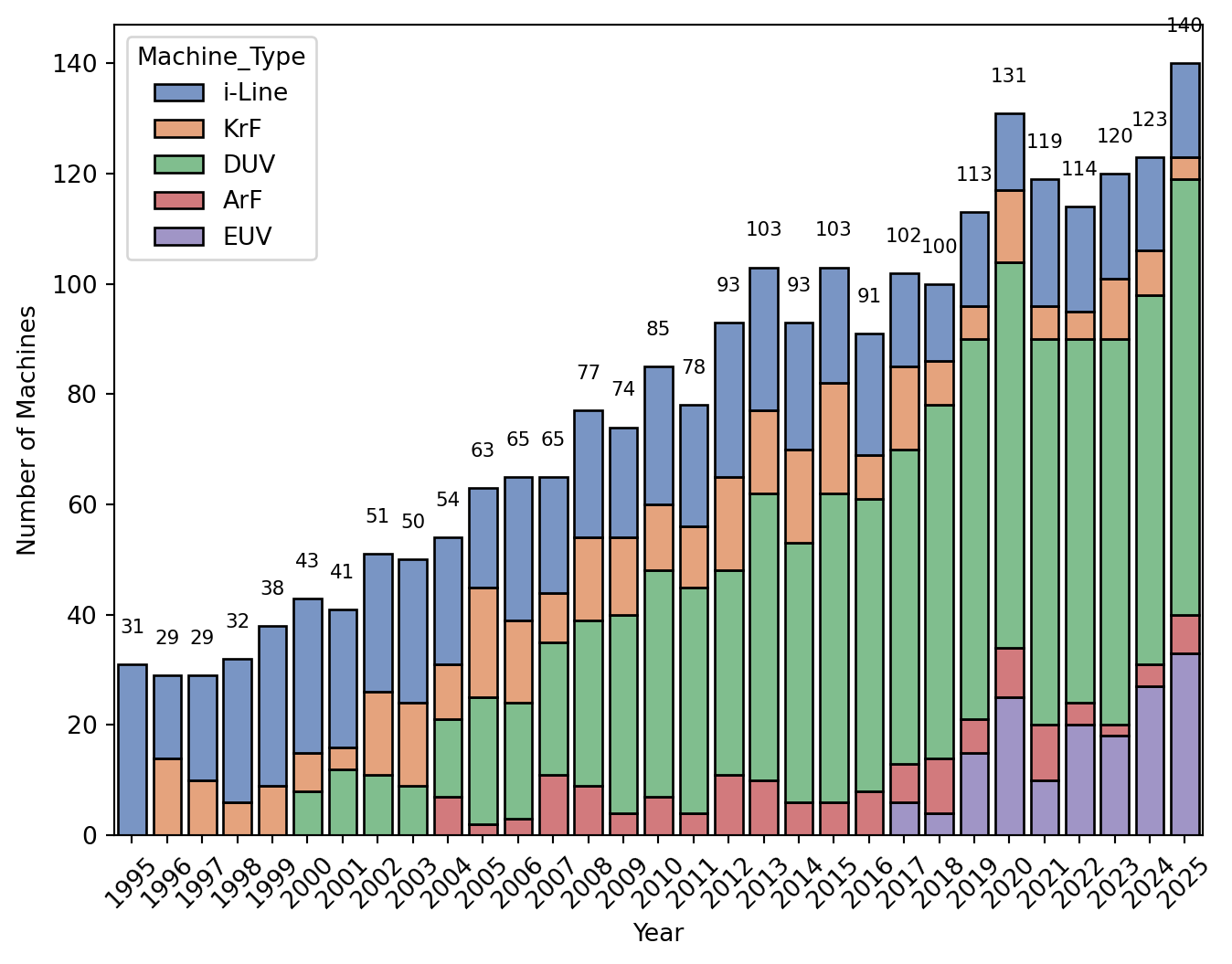
Figure 4.7 illustrates the distribution of machine orders over the years, showing the uptake of different machine types (e.g., EUV, DUV) and the growth of ASML’s customer base. In total, ASML has sold 15,406 machines.
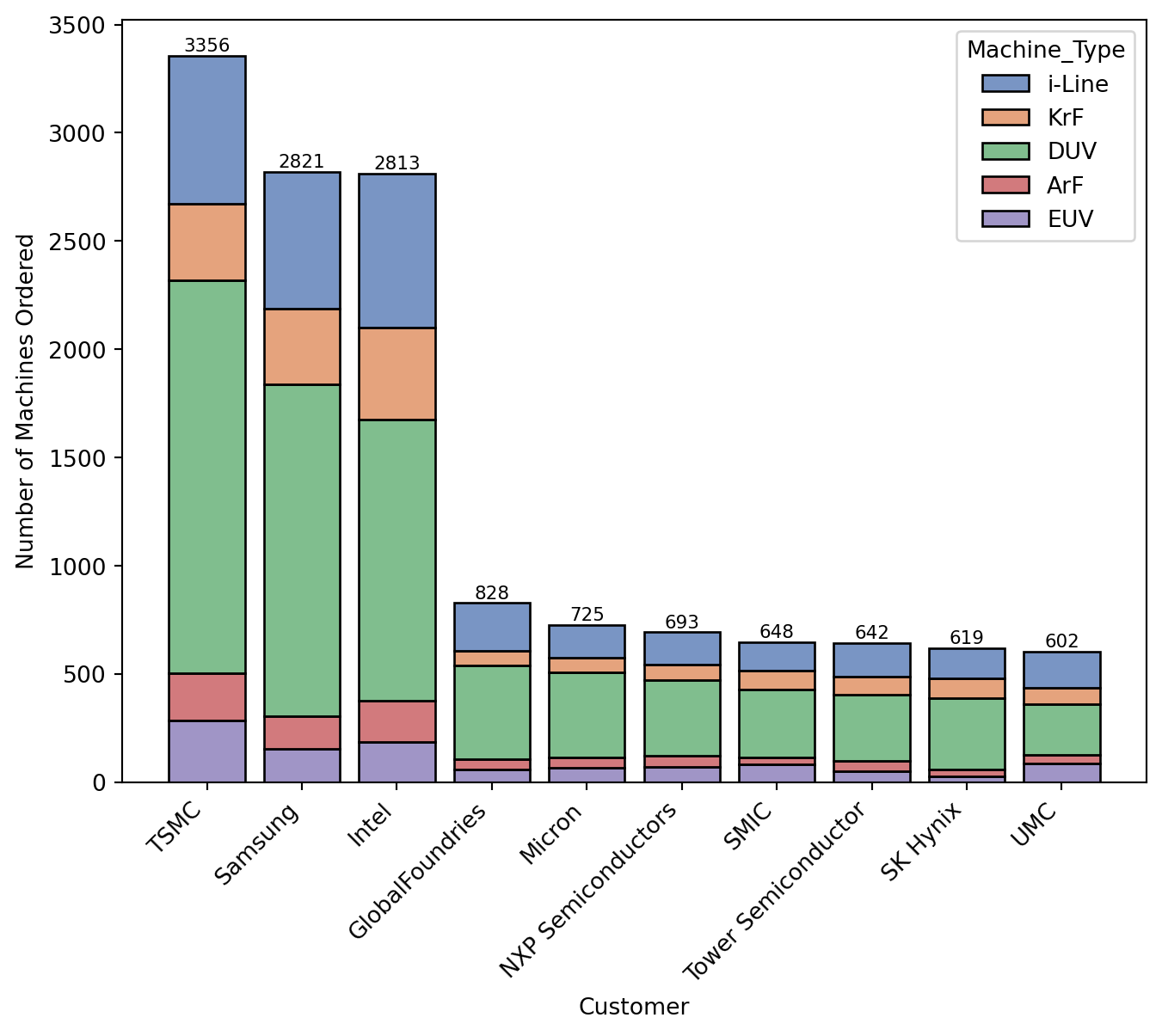
The number of machines ordered by the top 10 customers is shown in Figure 4.8, which highlights the concentration of orders among a few key customers. The top three customers account for about 58% of all machines sold.
| Customer_ID | Fab_ID | Machine_Model | Count | Order_Date | Delivery_Date | |
|---|---|---|---|---|---|---|
| Order_ID | ||||||
| 000003219950527 | C000-TSMC | TSMC-ARI-US | PAS5500350C | 5 | 1995-05-27 | 1996-07-17 |
| 000003419951114 | C000-TSMC | TSMC-ARI-US | PAS5500100D | 5 | 1995-11-14 | 1996-10-04 |
| 000003319951214 | C000-TSMC | TSMC-ARI-US | PAS5500350C | 5 | 1995-12-14 | 1996-05-18 |
| 000006019960325 | C000-TSMC | TSMC-ARI-US | PAS5500275D | 4 | 1996-03-25 | 1997-10-06 |
| 000009019970527 | C000-TSMC | TSMC-ARI-US | PAS5500275D | 4 | 1997-05-27 | 1998-04-10 |
| ... | ... | ... | ... | ... | ... | ... |
| 000216820221016 | C030-VI | VI-SIN-SG | TWINSCANNXE3400C | 4 | 2022-10-16 | 2023-05-21 |
| 000228420240201 | C030-VI | VI-SIN-SG | NXT2150i | 4 | 2024-02-01 | 2024-09-17 |
| 000241720240417 | C030-VI | VI-SIN-SG | PAS5500100D | 5 | 2024-04-17 | 2025-12-28 |
| 000228620240421 | C030-VI | VI-SIN-SG | TWINSCANNXE3600D | 4 | 2024-04-21 | 2024-05-15 |
| 000241420240818 | C030-VI | VI-SIN-SG | TWINSCANNXT870B | 5 | 2024-08-18 | 2025-12-16 |
4743 rows × 6 columns
4.9 Customer Fabrication Plants (Fabs)
ASML’s customers operate fabrication plants (fabs) where lithography machines are installed. These fabs are located globally, with a concentration in regions like Taiwan, South Korea, the United States, and Europe. Each fab has a unique identifier and is associated with specific machine models. The dataset includes details such as fab location, customer name, and installed machine models. Table Table 4.14 shows a sample of fabs operated by ASML’s customers.
| Customer | Fab_Location | Latitude | Longitude | |
|---|---|---|---|---|
| Fab_ID | ||||
| ACD-KAO-TW | AsiaChip Dynamics | Kaohsiung, Taiwan | 22.6200 | 120.3100 |
| CCI-PEN-MY | ChipCore Industries | Penang, Malaysia | 5.4000 | 100.5700 |
| CWS-TOU-FR | ChipWave Solutions | Toulouse, France | 43.6040 | 1.4440 |
| FCT-JUR-SG | FabCore Technologies | Jurong, Singapore | 1.3510 | 103.8650 |
| GCC-AUS-US | GlobalChip Corp | Austin, Texas, United States | 30.4000 | -97.6700 |
| GF-SIN-SG | GlobalFoundries | Singapore | 1.3510 | 103.8650 |
| GF-MAL-US | GlobalFoundries | Malta, New York, United States | 42.9700 | -73.7900 |
| GF-DRE-DE | GlobalFoundries | Dresden, Germany | 51.0942 | 13.7810 |
| IT-REG-DE | Infineon Technologies | Regensburg, Germany | 49.0150 | 12.0950 |
| IT-VIL-AT | Infineon Technologies | Villach, Austria | 46.6100 | 13.8500 |
| I-LEI-IE | Intel | Leixlip, Ireland | 53.3799 | -6.5920 |
| I-KIR-IL | Intel | Kiryat Gat, Israel | 31.6110 | 34.7660 |
| I-HIL-US | Intel | Hillsboro, Oregon, United States | 45.5800 | -122.9100 |
| I-CHA-US | Intel | Chandler, Arizona, United States | 33.3000 | -111.8800 |
| K-YOK-JP | Kioxia | Yokkaichi, Japan | 34.9650 | 136.6200 |
| K-KIT-JP | Kioxia | Kitakami, Japan | 39.2860 | 141.1170 |
| MFI-TOK-JP | MicroFab Innovations | Tokyo, Japan | 35.6250 | 139.7400 |
| M-BOI-US | Micron | Boise, Idaho, United States | 43.5800 | -116.2200 |
| M-HIR-JP | Micron | Hiroshima, Japan | 34.4300 | 132.7500 |
| M-SIN-SG | Micron | Singapore | 1.3510 | 103.8650 |
| NXPS-EIN-NL | NXP Semiconductors | Eindhoven, Netherlands | 51.4167 | 5.4750 |
| NXPS-SIN-SG | NXP Semiconductors | Singapore | 1.3510 | 103.8650 |
| NFT-SUZ-CN | NanoFab Technologies | Suzhou, China | 31.2990 | 120.5850 |
| NTS-HAI-IL | NanoTech Systems | Haifa, Israel | 32.7940 | 34.9890 |
| RE-NAK-JP | Renesas Electronics | Naka, Japan | 36.3800 | 140.4700 |
| RE-SAI-JP | Renesas Electronics | Saijo, Japan | 34.4300 | 132.7500 |
| SKH-WUX-CN | SK Hynix | Wuxi, China | 31.5500 | 120.3500 |
| SKH-ICH-KR | SK Hynix | Icheon, South Korea | 37.2300 | 127.4900 |
| SMIC-SHA-CN | SMIC | Shanghai, China | 31.1850 | 121.5870 |
| SMIC-BEI-CN | SMIC | Beijing, China | 39.9590 | 116.4620 |
| STM-AGR-IT | STMicroelectronics | Agrate Brianza, Italy | 45.5500 | 9.3500 |
| STM-CRO-FR | STMicroelectronics | Crolles, France | 45.2977 | 5.8980 |
| STM-SIN-SG | STMicroelectronics | Singapore | 1.3510 | 103.8650 |
| S-HWA-KR | Samsung | Hwaseong, South Korea | 37.2000 | 127.0700 |
| S-PYE-KR | Samsung | Pyeongtaek, South Korea | 37.0400 | 127.1000 |
| S-AUS-US | Samsung | Austin, United States | 30.4000 | -97.6700 |
| SNT-MUN-DE | SemiNova Tech | Munich, Germany | 48.1370 | 11.5750 |
| STS-SIN-SG | SemiTech Solutions | Singapore | 1.3510 | 103.8650 |
| SEC-SAN-US | SiliconEdge Corp | San Jose, California, United States | 37.4100 | -121.9500 |
| TSMC-HSI-TW | TSMC | Hsinchu, Taiwan | 24.8050 | 120.9750 |
| TSMC-TAI-TW | TSMC | Tainan, Taiwan | 23.0900 | 120.3000 |
| TSMC-KUM-JP | TSMC | Kumamoto, Japan | 32.8600 | 130.7900 |
| TSMC-ARI-US | TSMC | Arizona, United States | 33.7200 | -112.1300 |
| TCI-SUW-KR | TechChip Innovations | Suwon, South Korea | 37.2600 | 127.0300 |
| TTS-YON-KR | TechTrend Semiconductors | Yongin, South Korea | 37.2300 | 127.2000 |
| TI-DAL-US | Texas Instruments | Dallas, Texas, United States | 32.9600 | -96.7100 |
| TI-RIC-US | Texas Instruments | Richardson, Texas, United States | 32.9600 | -96.7100 |
| TI-FRE-DE | Texas Instruments | Freising, Germany | 48.4020 | 11.7480 |
| TS-NEW-US | Tower Semiconductor | Newport Beach, United States | 33.6200 | -117.9300 |
| TS-MIG-IL | Tower Semiconductor | Migdal Haemek, Israel | 32.6770 | 35.2400 |
| UMC-SIN-SG | UMC | Singapore | 1.3510 | 103.8650 |
| UMC-HSI-TW | UMC | Hsinchu, Taiwan | 24.8050 | 120.9750 |
| VI-HSI-TW | Vanguard International | Hsinchu, Taiwan | 24.8050 | 120.9750 |
| VI-SIN-SG | Vanguard International | Singapore | 1.3510 | 103.8650 |
| WD-YOK-JP | Western Digital | Yokkaichi, Japan | 34.9650 | 136.6200 |
| WD-FRE-US | Western Digital | Fremont, California, United States | 37.4100 | -121.9500 |
| XFSF-KUC-MY | X-Fab Silicon Foundries | Kuching, Malaysia | 1.5570 | 110.3590 |
| XFSF-ERF-DE | X-Fab Silicon Foundries | Erfurt, Germany | 50.9787 | 11.0328 |
Make this Notebook Trusted to load map: File -> Trust Notebook
4.10 Returnable Transport Materials (RTMs)
ASML’s global semiconductor equipment operations require sophisticated logistics to transport highly sensitive and valuable components across continents. The company employs Returnable Transport Materials (RTMs)—specialized packaging systems designed for multiple use cycles to optimize costs and environmental impact.
The RTMs are transhipped across ASML’s warehouse network so that parts can be efficiently routed from suppliers to manufacturing sites and ultimately to customers. Each RTM type is engineered to accommodate specific part size classes, ensuring optimal protection and handling during transit.
Table 4.15 summarizes the key parameters of ASML’s RTM systems, which are categorized based on the size of parts they handle:
- Identity and classification:
rtm_id: Unique identifier for tracking individual RTM units.rtm_name: Descriptive name of the RTM type.description: Explanation of the RTM’s purpose and applications.applicable_size_classes: List of part size classes (e.g., XS, S, M, L, XL, XXL) that can use this RTM.- Small Components (XS/S): Micro-totes and cassettes for high-volume, frequent-use.
- Medium Components (M/L): Flight cases and crates for precision instruments.
- Large Components (XL/XXL): Specialized systems for major subsystems and complete modules.
- Physical parameters:
footprint_m2: Storage footprint in square meters.chargeable_weight_kg: Weight used by air freight carriers for cost calculation.
- Economic parameters:
price_new_eur: Purchase price for a new RTM unit.rtm_holding_cost_per_day: Daily carrying cost while RTM is in inventory.cleaning_cost_per_cycle: Cost to clean and prepare RTM for reuse.repair_cost_per_cycle: Average repair and maintenance cost per use cycle.disposal_cost_eur: Cost incurred when RTM reaches end-of-life.backorder_cost_per_day: Penalty cost for each day an RTM is unavailable.monitoring_fee_per_shipment: Cost for tracking and shipment visibility services.
- Operational parameters:
lead_time_new_days: Lead time in days to procure a new RTM and deliver it to the central warehouse in Veldhoven.lead_time_clean_days: Lead time in days to clean an RTM to service.max_cycles: Maximum number of use cycles before mandatory disposal.
- Technical specifications:
esd: Indicates electrostatic discharge protection capability.cleanroom: Indicates cleanroom compatibility.
| rtm_name | description | applicable_size_classes | footprint_m2 | chargeable_weight_kg | price_new_eur | rtm_holding_cost_per_day | cleaning_cost_per_cycle | repair_cost_per_cycle | disposal_cost_eur | backorder_cost_per_day | monitoring_fee_per_shipment | max_cycles | lead_time_new_days | lead_time_clean_days | esd | cleanroom | |
|---|---|---|---|---|---|---|---|---|---|---|---|---|---|---|---|---|---|
| rtm_id | |||||||||||||||||
| RTM_001 | ESD micro-tote (cleanroom) | Small ESD-safe tote for delicate electronic co... | S,XS | 0.06 | 1.2 | 45.0 | 0.15 | 2.0 | 3.5 | 8.0 | 12.0 | 0.0 | 200 | 14 | 3 | True | True |
| RTM_002 | Micro cassette / divider tray (cleanroom) | Precision cassette for wafer handling components | S,XS | 0.04 | 0.8 | 35.0 | 0.12 | 2.5 | 4.0 | 6.0 | 15.0 | 0.0 | 150 | 10 | 2 | False | True |
| RTM_003 | Returnable modular crate | Standard modular shipping crate for medium com... | M,S | 0.25 | 8.5 | 120.0 | 0.30 | 1.5 | 8.0 | 25.0 | 35.0 | 0.0 | 300 | 7 | 1 | False | False |
| RTM_004 | Cleanroom tote (ESD-safe) | ESD-safe cleanroom tote for sensitive optical ... | M,S | 0.36 | 12.0 | 185.0 | 0.35 | 3.0 | 12.0 | 40.0 | 55.0 | 0.0 | 250 | 21 | 4 | True | True |
| RTM_005 | Reusable flight case | Shock-resistant flight case for precision inst... | M | 0.48 | 25.0 | 340.0 | 0.60 | 1.0 | 18.0 | 75.0 | 85.0 | 5.0 | 180 | 35 | 2 | False | False |
| RTM_006 | Shock/tilt monitored crate | IoT-enabled crate with shock and tilt monitoring | L,M | 0.64 | 35.0 | 580.0 | 0.80 | 1.0 | 35.0 | 120.0 | 150.0 | 12.0 | 120 | 45 | 5 | False | False |
| RTM_007 | Pallet + cage (stillage) | Heavy-duty pallet with protective cage structure | L | 1.20 | 45.0 | 280.0 | 0.40 | 0.0 | 25.0 | 85.0 | 75.0 | 4.0 | 400 | 21 | 1 | False | False |
| RTM_008 | Industrial freight container (ESD-safe) | Large ESD-safe container for major subsystems | L,XL | 2.40 | 85.0 | 1200.0 | 1.50 | 8.0 | 75.0 | 250.0 | 300.0 | 25.0 | 150 | 60 | 7 | True | True |
| RTM_009 | Climate-controlled shipping module | Temperature/humidity controlled module for optics | XL | 3.60 | 160.0 | 2800.0 | 2.80 | 15.0 | 180.0 | 450.0 | 750.0 | 50.0 | 100 | 90 | 10 | True | True |
| RTM_010 | Heavy-duty transport frame (vibration-isolated) | Vibration-isolated frame for precision mechani... | XL,XXL | 4.80 | 280.0 | 4500.0 | 4.20 | 25.0 | 350.0 | 850.0 | 1200.0 | 100.0 | 80 | 120 | 14 | True | True |
| RTM_011 | Multi-modal shipping system (air/truck/crane) | Complete logistics system for EXE:5000 modules... | XXL | 8.00 | 650.0 | 12000.0 | 8.50 | 50.0 | 800.0 | 2200.0 | 2500.0 | 250.0 | 60 | 180 | 21 | True | True |
4.11 Transportation Requirements for ASML Machines
Transporting ASML machines requires a significant number of crates and freight containers due to their size and complexity. The exact number can vary based on the machine type and configuration. For example, transporting the TWINSCAN EXE:5000 system involves more than 250 crates and 43 freight containers (Intel Newsroom 2024).
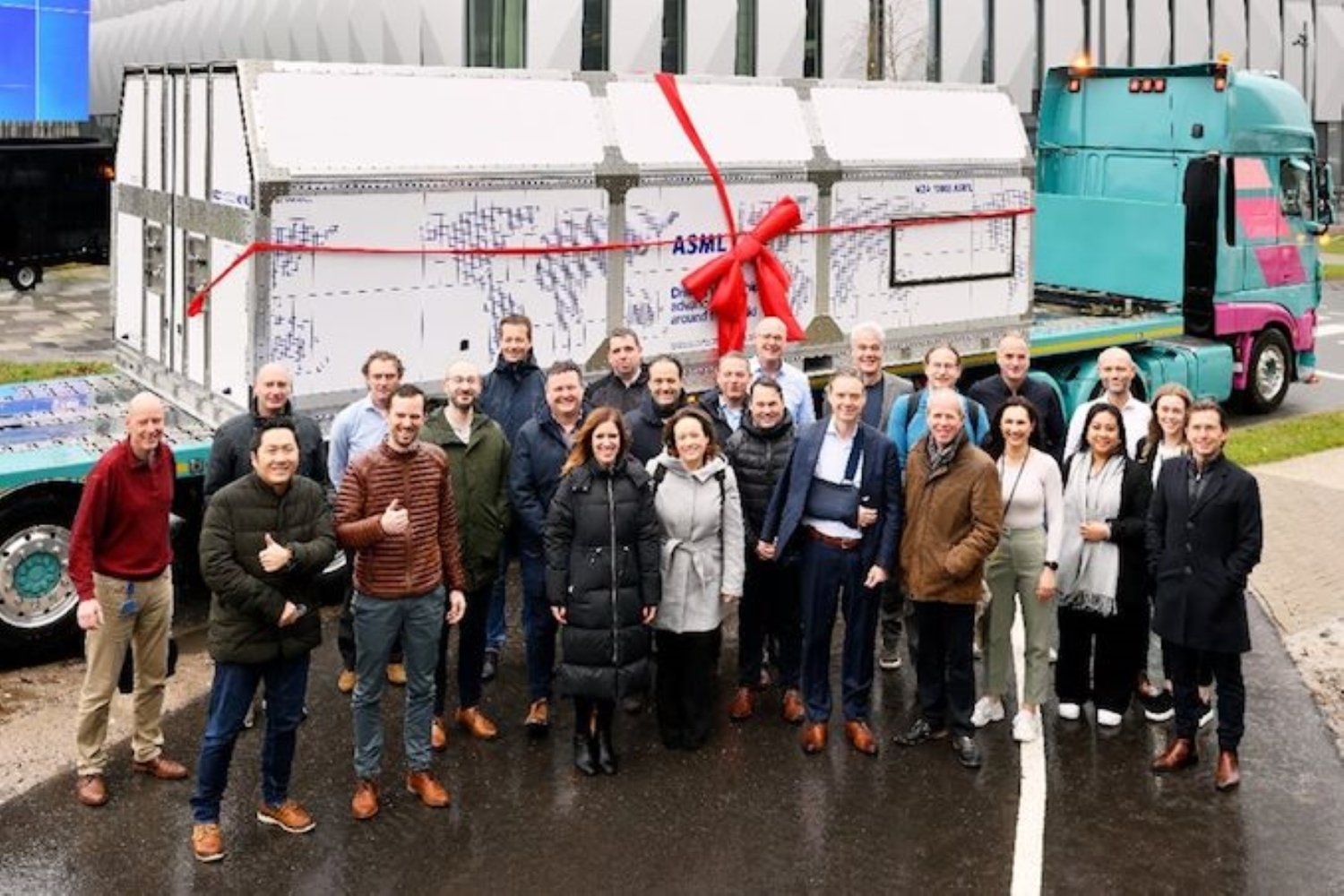
Table 4.16 shows the estimated number of crates and freight containers needed for different ASML machine types based on their volumes.
| n_crates | n_containers | |
|---|---|---|
| type | ||
| EXE | 250 | 43 |
| NXE | 280 | 49 |
| NXT | 120 | 21 |
| PAS | 46 | 8 |
4.12 Carrier Profiles and Transportation Lanes
ASML leverages transportation to connect its multi-echelon network to customer fabs by aligning urgency, value-at-risk, and distance with the most suitable mode × carrier combination. The analysis focuses on three key decision factors: (1) cost, represented as €/kg; (2) time, encompassing transport lead time derived from fixed terminal handling, mode-specific line-haul speeds, and additional schedule/customs buffers; and (3) reliability, reflecting the on-time probability critical for meeting SLAs and avoiding costly downtime penalties.
Table 4.17 provides region-to-region transportation tariffs per mode with €/kg and €/m³ (air volumetric, 167 kg/m³). The columns are:
- Region_1: The origin region (EMEA, Americas, APAC).
- Region_2: The destination region (EMEA, Americas, APAC).
- Mode: The transportation mode (air, ground, sea).
- EUR_per_kg: The expected price per kilogram for the mode and region pair
- EUR_per_m3_at_167: The expected price per cubic meter for air mode using the IATA volumetric rule (167 kg/m³). Not applicable for ground and sea modes.
| EUR_per_kg | |||
|---|---|---|---|
| Region_1 | Region_2 | Mode | |
| EMEA | EMEA | air | 16.14 |
| ground | 2.26 | ||
| sea | 0.82 | ||
| Americas | air | 19.52 | |
| sea | 0.99 | ||
| APAC | air | 19.76 | |
| sea | 0.92 | ||
| Americas | EMEA | air | 19.38 |
| sea | 0.91 | ||
| Americas | air | 16.14 | |
| ground | 2.26 | ||
| sea | 0.82 | ||
| APAC | air | 19.71 | |
| sea | 0.92 | ||
| APAC | EMEA | air | 20.86 |
| sea | 0.96 | ||
| Americas | air | 20.10 | |
| sea | 0.96 | ||
| APAC | air | 16.14 | |
| ground | 2.26 | ||
| sea | 0.82 |
Table 4.18 presents mode speeds, fixed handling times, and service buffers. The columns are:
- Mode: The transportation mode (air, ground, sea).
- Linehaul_Speed_kmh: The indicative average hub-to-hub speed in kilometers per hour used for conceptual transit reasoning2.
- Fixed_Terminal_days: The typical handling time at terminals (handover, staging, cut-off effects) before line-haul starts, expressed in days.
- Sched_Wait_days_min / Sched_Wait_days_max: A range for additional schedule wait (e.g., sailing day for sea, flight bank for air).
- Customs_days_min / Customs_days_max: A range for customs clearance variability (export/import), in days.
- OnTimeRate_mean: The expected on-time probability (mode-level).
| Linehaul_Speed_kmh | Fixed_Terminal_days | Sched_Wait_days_min | Sched_Wait_days_max | Customs_days_min | Customs_days_max | OnTimeRate_mean | |
|---|---|---|---|---|---|---|---|
| Mode | |||||||
| air | 825.0 | 1.01 | 0.1 | 0.5 | 0.0 | 1.0 | 0.887 |
| ground | 63.0 | 0.84 | 0.1 | 0.2 | 0.0 | 0.2 | 0.826 |
| sea | 33.0 | 5.00 | 0.0 | 7.0 | 0.0 | 3.0 | 0.599 |
Table 4.19 presents carrier profiles with the following columns:
- Carrier: The logistics provider (e.g., DHL, FedEx, UPS, Maersk, DB Schenker).
- Mode: The mode that carrier provides in this dataset (air, ground, or sea).
- EUR_per_kg_intra: The expected price per kilogram for intra-region moves for this carrier × mode.
- Speed_kmh_effective: The carrier’s indicative line-haul speed for that mode.
- OnTimeRate: The expected on-time probability for this carrier × mode, aligned with mode-level reliability priors.
| EUR_per_kg_intra | Speed_kmh_effective | OnTimeRate | ||
|---|---|---|---|---|
| Carrier | Mode | |||
| DHL | air | 16.71 | 741 | 0.887 |
| ground | 2.15 | 63 | 0.826 | |
| sea | 0.82 | 33 | 0.599 | |
| FedEx | air | 15.57 | 748 | 0.887 |
| ground | 2.25 | 63 | 0.826 | |
| UPS | air | 16.90 | 726 | 0.887 |
| ground | 2.39 | 63 | 0.826 | |
| Maersk | sea | 0.86 | 33 | 0.599 |
| DB Schenker | air | 14.36 | 755 | 0.887 |
| ground | 2.28 | 63 | 0.826 | |
| sea | 0.82 | 33 | 0.599 |
What is the rationale for on-time and damage rates? ASML’s logistics network is designed to balance speed, cost, and reliability. The on-time rates reflect the carriers’ performance in meeting delivery schedules, which is crucial for minimizing downtime at customer fabs. Damage rates are included to account for the risk of part damage during transit, which can lead to additional costs and delays. Delays can be particularly costly for ASML, as they may lead to extended machine downtimes at customer sites, impacting production schedules and customer satisfaction.
4.13 Service Level Agreements (SLAs)
In chip manufacturing, uptime is critical. ASML offers various Service Level Agreements (SLAs) to its customers, defining the expected performance and availability of their lithography systems. These SLAs typically include:
- Availability Guarantees: Commitments to ensure that systems are operational and available for use a certain percentage of the time.
- Response Times: Defined timeframes within which ASML will respond to service requests or issues.
Table 4.20 provides an overview of typical SLA parameters for ASML lithography systems.
| SLA Level | Availability (%) | Max Downtime (hours/year) | Response Time (hours) |
|---|---|---|---|
| Basic | 95 | 438 | 24 |
| Standard | 98 | 175 | 12 |
| Premium | 99.5 | 44 | 4 |
The top 20% of customers are Premium, the next 50% are Standard, and the rest are Basic.
When SLAs are violated, ASML faces penalties. Table 4.21 outlines the penalty structure for SLA violations.
| Violation Type | Fixed Penalty (€) | Penalty per Hour (€) |
|---|---|---|
| Downtime due to missing spare parts | 500 | 100 |
| Downtime due to missing service tools | 250 | 50 |
4.14 References
ASML. 2025a. “ASML Products & Services: Supplying the Semiconductor Industry.” ASML. 2025. https://www.asml.com/en/products.
———. 2025b. “Sourcing & Supply Chain – Teams at ASML.” ASML. 2025. https://www.asml.com/en/careers/teams/sourcing-and-supply-chain.
“ASML EUV Lithography Systems.” 2025. ASML. 2025. https://www.asml.com/en/products/euv-lithography-systems.
Bloomberg News. 2024. “ASML Shows Off $380M, 165-Ton Machine Behind AI Shift,” February 13, 2024. https://www.datacenterknowledge.com/ai-data-centers/asml-shows-off-380m-165-ton-machine-behind-ai-shift.
Intel Newsroom. 2024. “With High NA EUV, Intel Foundry Opens New Frontier in Chipmaking.” April 18, 2024. https://newsroom.intel.com/intel-foundry/intel-foundry-opens-new-frontier-chipmaking.
LaPedus, Mark. 2016. “Why EUV Is So Difficult.” Semiconductor Engineering. November 17, 2016. https://semiengineering.com/why-euv-is-so-difficult/.
Mat Honanarchive, and James O’Donnellarchive. 2024. “How ASML Took over the Chipmaking Chessboard.” MIT Technology Review. January 4, 2024. https://www.technologyreview.com/2024/04/01/1090393/how-asml-took-over-the-chipmaking-chessboard/.
“NXT:1980Fi.” 2016. ASML. 2016. https://www.asml.com/en/products/duv-lithography-systems/twinscan-nxt1980fi.
“NXT:2100i.” 2017. ASML. 2017. https://www.asml.com/en/products/duv-lithography-systems/twinscan-nxt2100i.
“NXT:2150i.” 2018. ASML. 2018. https://www.asml.com/en/products/duv-lithography-systems/twinscan-nxt-2150i.
PAS 5500/100D. 2019. Manual. ASML. https://edge.sitecorecloud.io/asmlnetherlaaea-asmlcom-prd-5369/media/project/asmlcom/asmlcom/asml/files/products/refurbished-products/pas-5500-100d.pdf.
PAS 5500/1150C. 2019. Manual. ASML. https://edge.sitecorecloud.io/asmlnetherlaaea-asmlcom-prd-5369/media/project/asmlcom/asmlcom/asml/files/products/refurbished-products/pas-5500-1150c.pdf.
PAS 5500/275D. 2019. Manual. ASML. https://edge.sitecorecloud.io/asmlnetherlaaea-asmlcom-prd-5369/media/project/asmlcom/asmlcom/asml/files/products/refurbished-products/pas-5500-275d.pdf.
PAS 5500/350C. 2019. Manual. ASML. https://edge.sitecorecloud.io/asmlnetherlaaea-asmlcom-prd-5369/media/project/asmlcom/asmlcom/asml/files/products/refurbished-products/pas-5500-350c.pdf.
PAS 5500/450F. 2019. Manual. ASML. https://edge.sitecorecloud.io/asmlnetherlaaea-asmlcom-prd-5369/media/project/asmlcom/asmlcom/asml/files/products/refurbished-products/pas-5500-450f.pdf.
PAS 5500/750F. 2019. Manual. ASML. https://edge.sitecorecloud.io/asmlnetherlaaea-asmlcom-prd-5369/media/project/asmlcom/asmlcom/asml/files/products/refurbished-products/pas-5500-750f.pdf.
PAS 5500/850C. 2019. Manual. ASML. https://edge.sitecorecloud.io/asmlnetherlaaea-asmlcom-prd-5369/media/project/asmlcom/asmlcom/asml/files/products/refurbished-products/pas-5500-850c.pdf.
PAS 5500/8TFH-a. 2019. Manual. ASML. https://edge.sitecorecloud.io/asmlnetherlaaea-asmlcom-prd-5369/media/project/asmlcom/asmlcom/asml/files/products/refurbished-products/pas-5500-8tfh-a.pdf.
“Refurbished Systems.” 2025. ASML. ASML. 2025. https://www.asml.com/en/products/refurbished-systems.
Tarasov, Katie. 2022. “ASML Is the Only Company Making the $200 Million Machines Needed to Print Every Advanced Microchip. Here’s an Inside Look.” CNBC: Technology, March 23, 2022. https://www.cnbc.com/2022/03/23/inside-asml-the-company-advanced-chipmakers-use-for-euv-lithography.html.
———. 2025. “Exclusive Look at the Creation of High NA, ASML’s New $400 Million Chipmaking Colossus.” CNBC. May 22, 2025. https://www.cnbc.com/2025/05/22/exclusive-look-at-high-na-asmls-new-400-million-chipmaking-colossus.html.
TweakTown. 2023. “ASML Ships Industry’s First High-NA EUV Lithography Scanner to Intel.” TweakTown. December 22, 2023. https://www.tweaktown.com/news/95120/asml-ships-industrys-first-high-na-euv-lithography-scanner-to-intel/index.html.
“TWINSCAN EXE:5000.” 2024. ASML. 2024. https://www.asml.com/en/products/euv-lithography-systems/twinscan-exe-5000.
“TWINSCAN EXE:5200B.” 2025. ASML. 2025. https://www.asml.com/en/products/euv-lithography-systems/twinscan-exe-5200b.
“TWINSCAN NXE:3400B.” 2017. ASML. 2017. https://www.asml.com/en/products/euv-lithography-systems/twinscan-nxe3400b.
“TWINSCAN NXE:3400C.” 2019. ASML. 2019. https://www.asml.com/en/products/euv-lithography-systems/twinscan-nxe3400c.
“TWINSCAN NXE:3600D.” 2021. ASML. 2021. https://www.asml.com/en/products/euv-lithography-systems/twinscan-nxe-3600d.
“TWINSCAN NXE:3800E.” 2024. ASML. 2024. https://www.asml.com/en/products/euv-lithography-systems/twinscan-nxe-3800e.
“TWINSCAN NXT:1470.” 2013. ASML. 2013. https://www.asml.com/en/products/duv-lithography-systems/twinscan-nxt1470.
“TWINSCAN NXT:2000i.” 2015. 2015. https://www.asml.com/en/products/duv-lithography-systems/twinscan-nxt2000i.
“TWINSCAN NXT:2050i.” 2019. ASML. 2019. https://www.asml.com/en/products/duv-lithography-systems/twinscan-nxt2050i.
“TWINSCAN NXT:870.” 2022. ASML. 2022. https://www.asml.com/en/products/duv-lithography-systems/twinscan-nxt870.
“TWINSCAN NXT:870B.” 2022. ASML. 2022. https://www.asml.com/en/products/duv-lithography-systems/twinscan-nxt-870b.
“TWINSCAN XT:1060K.” 2006. ASML. 2006. https://www.asml.com/en/products/duv-lithography-systems/twinscan-xt-1060k.
“TWINSCAN XT:1460K.” 2008. ASML. 2008. https://www.asml.com/en/products/duv-lithography-systems/twinscan-xt1460k.
“TWINSCAN XT:400M.” 2025. ASML. 2025. https://www.asml.com/en/products/duv-lithography-systems/twinscan-xt-400m.
“TWINSCAN XT:860M.” 2021. ASML. 2021. https://www.asml.com/en/products/duv-lithography-systems/twinscan-xt-860m.
“TWINSCAN XT:860N.” 2021. ASML. 2021. https://www.asml.com/en/products/duv-lithography-systems/twinscan-xt860n.
ZEISS. 2024. “High-NA-EUV: New Technology for Global Microchip Production.” Manufacturer Website. ZEISS. January 30, 2024. https://www.zeiss.com/semiconductor-manufacturing-technology/news-and-events/smt-press-releases/2024/high-na-euv-lithography.html.